
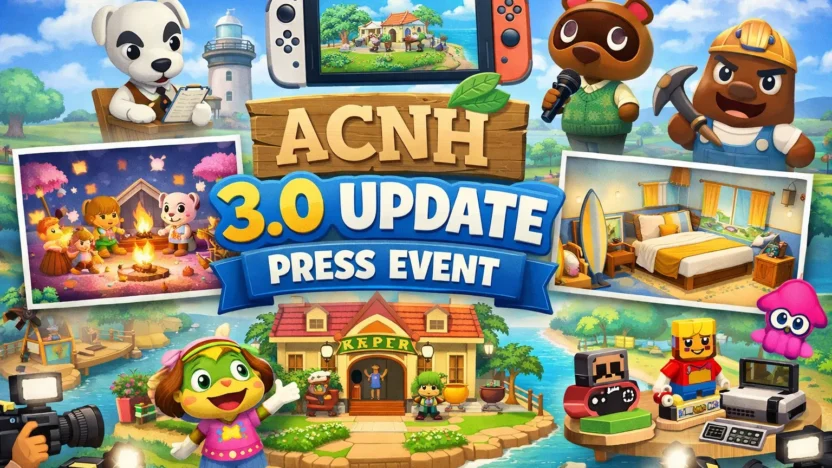
Nintendo recently held a closed-door press event to preview the upcoming 3.0 update for Animal Crossing: New Horizons. While fans didn’t get a live presentation or new trailer, the embargo has now lifted, allowing journalists and creators who attended to share exactly what they saw.
Much of the update builds on what was teased in the original announcement, but the press event confirmed several important details, limitations, and design choices that dramatically clarify how the update will actually work. Below is a complete, clean breakdown of everything that was officially confirmed.
Nintendo Switch 2 Edition: A Smoother, Smarter Way to Play
The Nintendo Switch 2 Edition is not required to enjoy the 3.0 update, but it adds several quality-of-life and presentation upgrades that directly affect how the game feels day to day.
Visual and Control Enhancements
On Switch 2, the game supports higher-resolution visuals in TV mode, making textures, furniture details, and environmental lighting noticeably sharper. Decorating, especially indoors, benefits the most from this clarity.
Mouse-style Joy-Con controls also make a big difference. Placing furniture, adjusting angles, and navigating menus feels more precise, particularly for players who spend a lot of time designing interiors or themed builds.
The Megaphone Returns (With Limits)
One of the most talked-about Switch 2 exclusives is the megaphone. This item allows you to call out villagers and special characters by name to help locate them on your island.
However, it isn’t a magic tracker:
- Characters only respond if they are outside
- Villagers inside homes, the museum, or far away will not answer
This mirrors how the megaphone worked in New Leaf and keeps it helpful without removing exploration entirely.
Multiplayer and Social Features
The Switch 2 Edition supports expanded online play and optional camera-based features for players who enjoy social sessions or content creation. While not essential, these additions make multiplayer feel more alive and expressive.
Slumber Islands: A True Creative Sandbox
Slumber Islands are one of the most important additions in 3.0 because they fundamentally change how players experiment with design.
What Is a Slumber Island?
A Slumber Island is a separate, dreamlike island space where you can freely decorate, terraform, and test ideas without affecting your main island. Think of it as a creative sandbox rather than a progression-based location.
You access Slumber Islands through a special system that runs parallel to normal island life.
Doze Codes and Online Rules
To invite friends to your Slumber Island, you’ll use a Doze Code, a sleep-themed version of a Dodo Code. This comes with strict rules:
- The island owner must be online
- There is no dream address
- Friends cannot visit when you are offline
- Local co-op is not supported (each player needs their own console and internet connection)
“What Happens on a Slumber Island Stays There”
This phrase was repeatedly emphasized at the press event—and it matters.
- Items used on Slumber Islands cannot be cataloged
- You cannot trade or export items
- Nothing carries back to your main island inventory
Friends can help move and place items during a session, but everything remains isolated to that Slumber Island.
Villagers, Music, and Atmosphere
Only villagers who already live on your main island can appear on your Slumber Islands. You cannot test new villagers or invite outsiders.
Slumber Islands also feature entirely new background music rather than hourly tracks, reinforcing the idea that these islands exist outside normal time and routine.
The Resort Hotel: Theme-Based Decorating With Progression
Another major pillar of the 3.0 update is the new Resort Hotel, run by Kapp’n’s family and located off your main island.
Eight Rooms, No More
The hotel contains exactly eight rooms, confirmed by both the trailer map and the press event. There are no hidden floors or expansions planned beyond these rooms.
Each room comes with a preset theme, such as:
- Seaside
- Japanese
- Modern
- Simple
- Ranch
- Kitty
- Dreamy
Unlike Happy Home Paradise, villagers do not request specific styles. Instead, you decorate based on the assigned theme, giving the experience a more structured, challenge-like feel.
Furniture Is Locked Behind Progression
When you first begin decorating hotel rooms, you cannot access your full catalog. Each theme provides a limited furniture set.
As you complete more rooms:
- Additional furniture options unlock
- More flexibility becomes available
- Creativity increases gradually instead of all at once
This progression system prevents the hotel from feeling overwhelming and gives players a reason to keep engaging with it long-term.
Leila Has No Hidden Role
Many players speculated that Leila (Kapp’n’s daughter) might offer special services. Nintendo confirmed she does not. She exists purely for conversation, just as she did in earlier games.
Hotel Guests on Your Island (But No Move-Ins)
Hotel guests don’t stay confined to the hotel. They will:
- Wander your island
- Visit Nook’s Cranny
- Sit in The Roost
- Explore the museum and public spaces
You’ll recognize them by their hotel clothing.
However, there is a firm limitation:
Hotel guests cannot be invited to move in permanently, even if you use Amiibo or form a connection with them. They function strictly as visitors, not potential residents.
Resetti’s Cleanup Service: A Major Quality-of-Life Upgrade
Resetti returns in 3.0 with a feature players have wanted since launch: bulk cleanup.
You can now:
- Clear specific areas or your entire island
- Remove furniture, weeds, flowers, and placed items
- Choose whether cleared items are stored or discarded
For players who frequently redesign or restart layouts, this dramatically reduces tedious cleanup time.
Storage, Crafting, and Daily Play Improvements
The 3.0 update also addresses long-standing frustrations:
- Expanded home storage, allowing thousands more items
- Plants, trees, and shrubs can now be stored
- Bulk crafting, letting you make multiple items at once
- Crafting materials can be pulled directly from storage
These changes don’t add flashy content, but they fundamentally improve how smooth the game feels.
Collaboration Items and Classic Nintendo Content
Nintendo confirmed several crossover details at the press event:
- LEGO-style items are available immediately and purchasable with Bells
- Splatoon and Zelda items remain Amiibo-locked
- Classic Nintendo console furniture each includes only one playable game
While these items were visible in the trailer, availability timing and limitations were clarified during the event.
Together, these changes make 3.0 feel less like a routine update and more like a thoughtful evolution of New Horizons.